What Is Lai Chau Ginseng and Where Is It Found?
“Black notoginseng,” “red notoginseng,” and “mountain ginseng” often appear in descriptions of medicinal herbs, making it easy for buyers to confuse notoginseng with Lai Chau ginseng. However, a dark-colored, multi-node, expensive root is not sufficient proof that it is Lai Chau ginseng. Confusion over names can cause buyers to choose the wrong ingredient, pay the wrong price, or have unrealistic expectations. This article provides initial identification signs and a process for verifying origin before purchase.
Lai Chau ginseng has the scientific name Panax vietnamensis var. fuscidiscus and is a variety of Vietnamese ginseng in the Araliaceae family. It is closely related to Ngoc Linh ginseng but is not identical to it. Therefore, beginners should start with three types of information: botanical identity, cultivation area, and test results, rather than relying solely on folk names or advertising claims.
Scientific Names Help Prevent Confusion Between Lai Chau Ginseng and Notoginseng
In the scientific name above, Panax is the genus, vietnamensis is the species, and var. fuscidiscus denotes the botanical variety. This naming convention identifies the plant more precisely than the term “notoginseng,” which is used rather loosely in many localities. Root skin color can also vary depending on the plant’s age, soil, processing method, and storage conditions, so “black” or “red” is not a reliable classification criterion.
The scientific name should be distinguished from commercial and local names. For example, a product may display “Lai Chau ginseng” on the front, but if its ingredient list states only “ginseng powder,” it still lacks sufficient verification data. A practical tip is to look for the full scientific name on the label, raw-material documentation, or test report, while also checking whether the product uses the root, leaves, or extract.
Northwestern Forests Form the Ecological Habitat of Lai Chau Ginseng
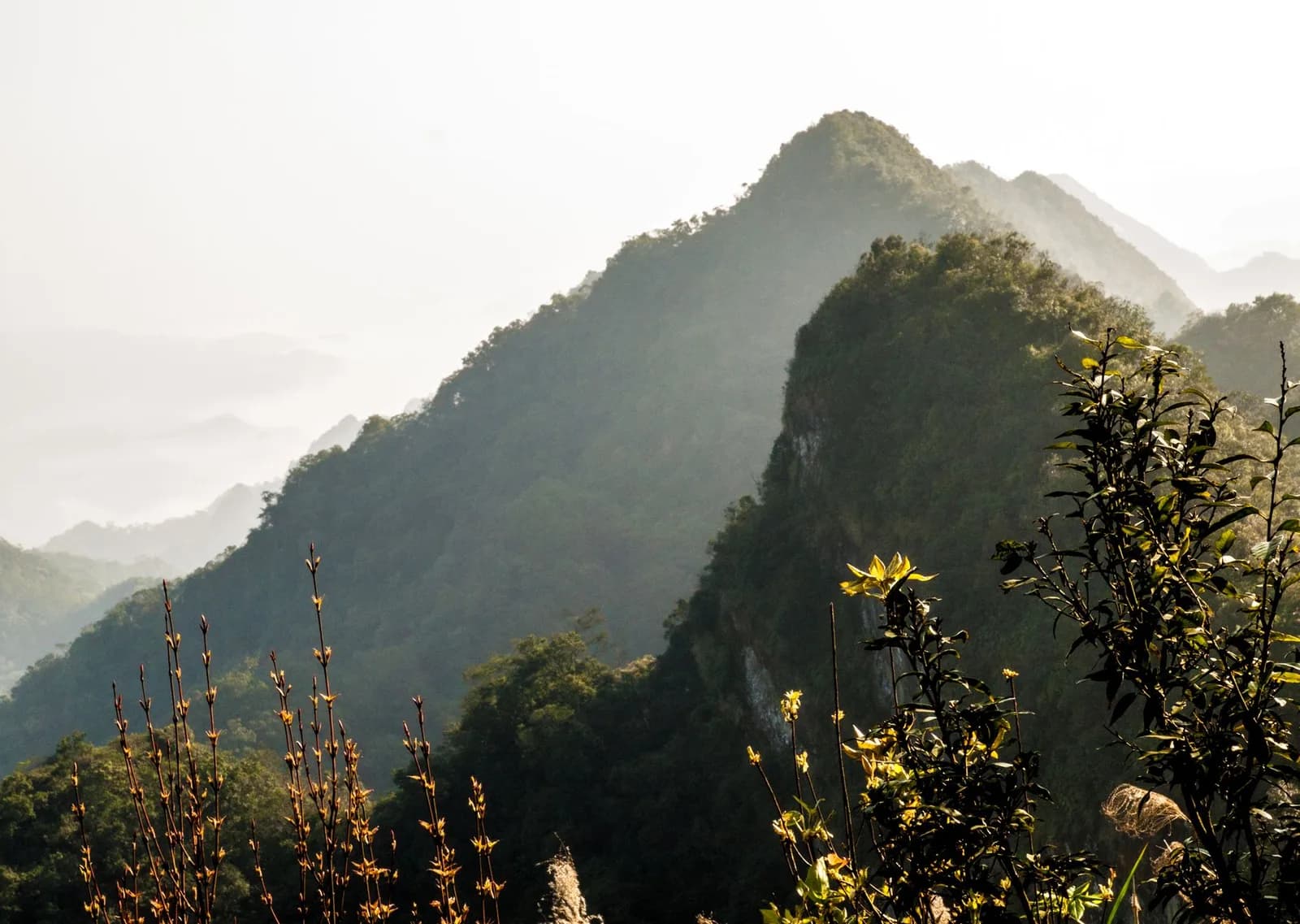
Lai Chau ginseng has been recorded in several mountainous areas of Lai Chau Province. The plant thrives in high-altitude environments beneath humid forest canopies. Diffused light protects it from harsh sunlight, while the humus layer, relatively stable humidity, and cool temperatures create an environment in which the rhizome develops slowly.
Interestingly, even plants from the same seed stock may differ in leaf size, number of nodes, and root shape when grown at different elevations, under different canopy cover, or in different soil types. Therefore, developing cultivation areas must go hand in hand with conserving genetic resources, documenting seed-stock batches, and tracing each growing area. A local name on the packaging cannot replace information about the cultivation area, harvest time, and raw-material control records.
Characteristics of Lai Chau Ginseng and a Reference Saponin Profile
Examining morphology is an initial screening step, especially when the plant still has intact leaves and fruit. However, roots that have been washed or sliced often lose many important identifying features. Plant age, harvest season, and ecological conditions can also cause considerable variations in appearance.
Observable signs on different plant parts
Plant part | Common signs | Identification value | Risk of confusion |
|---|---|---|---|
Stem | Aerial stem | Moderate | Easily confused with other Panax plants |
Leaves | Palmately compound leaves, possibly hairy | Quite useful when the plant is fresh | Varies by habitat |
Fruit | Nearly kidney-shaped, changing color when ripe | Reference characteristic | Ripe color is not consistent |
Root | Elongated, with node scars, and may be branched | Low when considered alone | Easily counterfeited |
The table shows that no single plant part is sufficient to confirm identity on its own. For high-value raw materials, chemical analysis and genetic data are more reliable than visually comparing roots.
Stems, Leaves, Fruit, and Roots Provide Initial Identification Signs
Wild plants typically have aerial stems and palmately compound leaves; both leaf surfaces may be hairy. The underground portion is generally elongated, bears node scars, and sometimes divides into several branches. However, plant age should not be inferred solely by counting the nodes, because damage, regeneration, and growing conditions can result in uneven growth marks.
The fruit is generally nearly kidney-shaped and may turn pink, orange, or yellow when ripe. Black spots on the seeds are a reference characteristic but not a natural “seal of authenticity.” This feature must be considered together with the leaves, stem, harvesting area, and specimen records.
The Saponin Profile Creates a Chemical Fingerprint
Compounds that may be examined in the chemical profile include majonoside R1, vinaginsenoside R2, ginsenoside Rb2, notoginsenoside Fc, notoginsenoside R2, and notoginsenoside R4. When analyzed together, this group of compounds can provide a more useful chemical profile than merely declaring “total saponins” without specifying the method or particular parameters.
Furthermore, concentrations may vary between wild and cultivated specimens, between young and mature plants, and among roots, leaves, and stems. Saponins are an important group of constituents, but they do not represent the entire value of the medicinal herb. A single high measurement also does not indicate purity, safety, or effectiveness in humans.
Correctly Identifying Lai Chau Ginseng Before Use
The greatest challenge is not a lack of comparison images, but the fact that Lai Chau ginseng, Ngoc Linh ginseng, and several medicinal herbs known as notoginseng share many similar characteristics. If buyers rely only on an attractive root, pleasant aroma, or sale price, they may pay for a product of the wrong origin and use something that does not meet their expectations.

However, it is important to note that compositional data and preclinical studies are not equivalent to clinical evidence in humans. Laboratory results should not be extrapolated into claims about treating disease, nor should information about medicinal herbs replace diagnosis, medication, or medical advice.
Genetic and Saponin Data Distinguish Lai Chau Ginseng from Ngoc Linh Ginseng
The two varieties belonging to Panax vietnamensis have considerable morphological and chemical similarities. Therefore, visual observation cannot provide a definitive conclusion. Even the statement “harvested in Lai Chau” is merely a declaration of origin without an accompanying traceability chain.
Analysis of metabolite profiles combined with genetic data can help distinguish and classify specimens. Saponin profiles provide reference data about chemical composition, while genetic data help verify relationships and origins more clearly. This is why high-value products should undergo batch-specific testing rather than merely include photographs of the cultivation area.
4 Steps for Choosing Lai Chau Ginseng with a Verifiable Origin
Previously, buyers may have had to guess based on root color and sales claims. After applying a verification process, their decisions can be based on more specific data. The bridge between these two approaches consists of the following four steps:
Verify the botanical identity, supplier, and location of the cultivation area.
Read the scientific name, plant part used, raw-material form, and stated concentration on the label.
Confirm that the test report matches the product name, batch number, and testing date.
Consult a qualified professional before use, especially if you are taking medication, pregnant, or have an underlying medical condition.
A high price, large root, or attractive appearance is not proof of authenticity. Before making payment, verify the scientific name, cultivation area, batch number, and test report by following the four steps above.